

For a wooden outdoor kitchen, use boiled linseed oil or a tung oil-based wood oil. The big difference lies in the drying time. At 20 degrees, boiled linseed oil is dry after about 24 hours, whereas pure raw linseed oil, according to the manufacturer Kreidezeit, only dries through after several weeks. Pure tung oil needs one to two weeks per coat, while a ready-made decking oil with driers can be recoated after 16 to 24 hours. So for a kitchen you still want to cook in this week, always choose an oil with driers.
Here you will find the differences between each type, the drying times at a glance and the care routine for Douglas fir, as part of the guide on how to look after your outdoor kitchen.
Raw linseed oil or boiled linseed oil?
For an outdoor kitchen, boiled linseed oil is the more usable of the two. Raw linseed oil does penetrate deepest into the wood, but its drying time is a real problem: the German garden site hausgarten.net reckons on at least a week for the first coat, and the natural paint maker Kreidezeit writes that wood treated with pure linseed oil only dries through after several weeks. The figures vary, and that is exactly the point: the purer the oil, the slower the oxidation.
Boiled linseed oil is linseed oil with added driers and, according to Kreidezeit, is dry and ready to recoat after about 24 hours at 20 degrees and 60 per cent humidity, or after 48 hours on tannin-rich wood such as oak. That means you can get a treatment done in a weekend. The oil is fully cured after about four weeks; during that time, go easy on the surface and keep water off it.
There are two things you should know. Clear boiled linseed oil contains no pigment and lets UV light through, so Douglas fir keeps on greying underneath it. And linseed oil yellows over time, which Kreidezeit calls “dark yellowing”.
The alternatives: tung oil and hardwax oil
Tung oil is the stronger alternative to linseed oil in places that get a lot of water. As it dries, the oil polymerises into a harder, more water-repellent layer than linseed oil. Sehestedter Naturfarben describes pure tung oil as hard and relatively brittle, which is why it is often mixed with the more elastic linseed oil.
Here too, the variety sets your pace: according to Sehestedter, pure tung oil takes one to two weeks to dry, while Hermann Sachse reckons on up to three weeks. Ready-made decking oils with driers, such as Leinos's linseed-based decking oil, are dry after 6 to 8 hours and can be recoated after 16 to 24 hours, so you build up the coats at a rate of one a day.
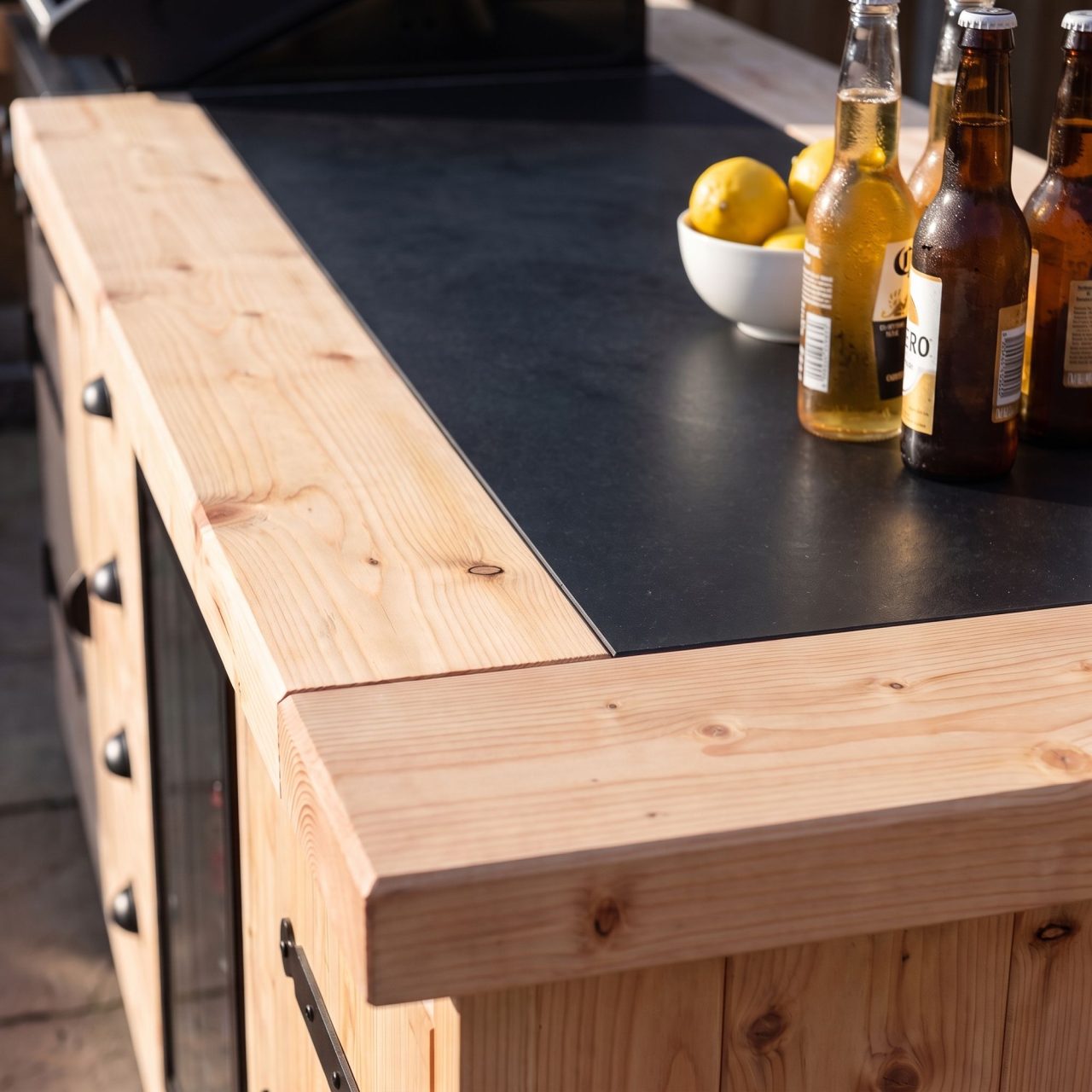
Hardwax oil combines oil with plant-based wax and is particularly interesting for worktops: the wax layer repels water and dirt and feels dry to the touch. With hardwax oil, check the full ingredient list, because “oil” in the name tells you little about the contents. In short: the carcass and modules do well with boiled linseed oil, while tung oil or hardwax oil is worthwhile for the worktop. If you would rather leave oiling the worktop behind, choose from our sintered stone worktop options, 12 millimetres thick. It stays just as it was delivered.
Drying times at a glance
| Oil | Drying time per coat (at 20 degrees) | Source |
|---|---|---|
| Raw linseed oil | at least one week up to several weeks | hausgarten.net, Kreidezeit |
| Boiled linseed oil | approx. 24 hours, 48 hours on oak | Kreidezeit |
| Pure tung oil | 1 to 2 weeks, up to 3 weeks depending on conditions | Sehestedter Naturfarben, Hermann Sachse |
| Decking oil with driers | dry in 6 to 8 hours, recoatable after 16 to 24 hours | Leinos |
Temperature matters too: below 10 degrees, oil soaks in poorly and dries sluggishly; Kreidezeit and Leinos both give 10 degrees as the minimum for application. So plan the job for spring or a dry day in late summer. Starting in November will not get you far.
Why Douglas fir deserves protection
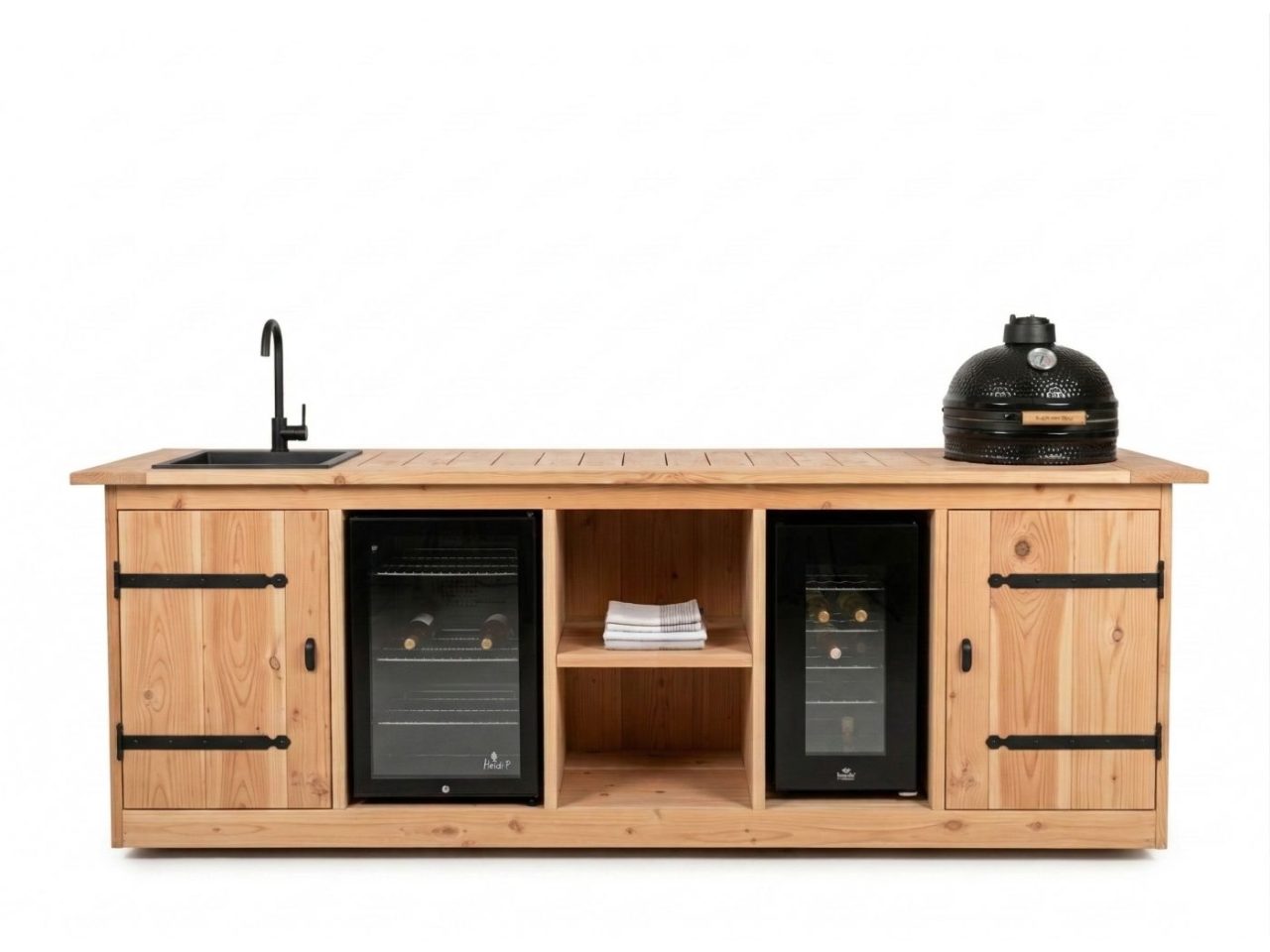
Douglas fir is a good choice in its own right when it comes to which wood suits an outdoor kitchen, and yet it still needs protection. Under DIN EN 350 its heartwood falls into durability class 3, European-grown Douglas fir into 3 to 4, on a scale from class 1 (at least 25 years) to class 5 (under 5 years). In concrete terms: untreated Douglas fir heartwood lasts 10 to 15 years outdoors, as long as it is kept off the ground. The sapwood, the paler outer part, is considerably more vulnerable. That is why we build every wooden outdoor kitchen in our 22 standard models from wood planed on both sides and dried. This keeps the moisture content low and the surface tight.
Untreated Douglas fir weathers to silver grey within a few seasons. That is purely cosmetic: UV light changes the colour, and some customers choose this quite deliberately. If you want to keep the warm, reddish-blond tone, the way to do it is yearly oiling with a pigmented oil. For extra protection against moisture, you can have a nano coating applied on top.
How to apply the oil
Applying oil is simple work if you stick to the order. Even so, it is not exactly fun. Expect an afternoon, oily hands and a garden that smells of linseed oil, and that every year. To give you an idea of the area: our widest model is 301 centimetres wide and 62 centimetres deep. The worktop alone therefore comes to almost 1.9 square metres, and with fronts and side modules there are roughly 8.5 square metres of wood that need oil. At a consumption of 0.05 to 0.1 litres per square metre per coat, as Kreidezeit specifies for boiled linseed oil, you need 0.4 to 0.85 litres per coat.
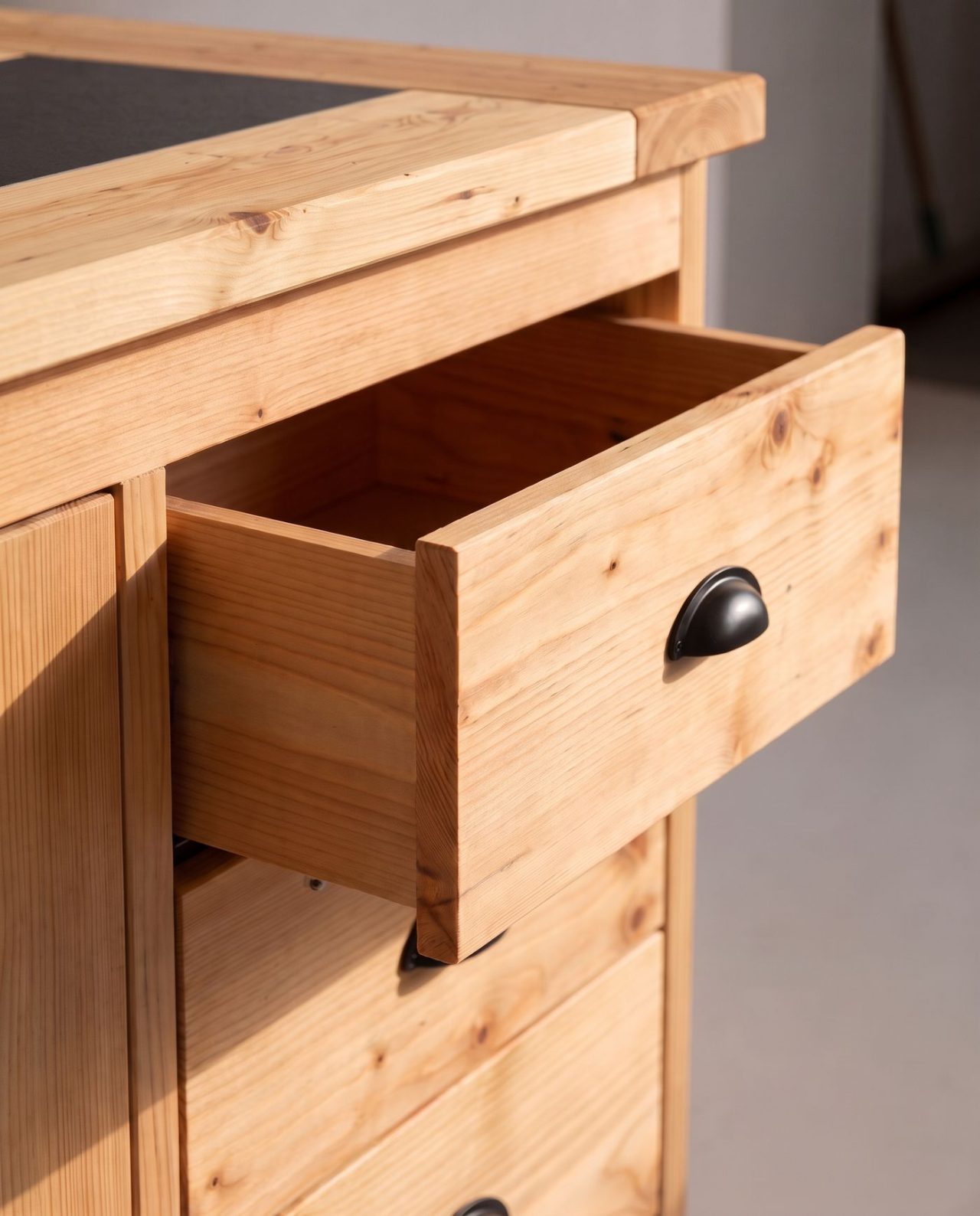
Clean the wood with water and soft soap and let it dry thoroughly. Then work with a brush or cloth in the direction of the grain, in thin coats. Thin really does mean thin. Our Douglas fir worktops are 3 centimetres thick, but the oil only needs to saturate the top few millimetres. Let each coat soak in for 10 to 20 minutes and rub off the excess with a clean cloth, otherwise you are left with sticky patches that never harden.
Apply the second coat as soon as the first is dry. On worktops, a third is fine. As a routine for a climate like Germany's: the whole kitchen once a year in spring, the worktop a second time after the summer. You can skip sanding when oiling; sanding between coats is only needed if wood fibres have raised. Each new coat simply reinforces the previous one.
Take care with oily rags
One more thing. The rags you use to wipe off linseed oil or tung oil can catch fire by themselves. As these oils dry they generate heat, and in a bundle of rags that heat builds up. The temperature can then rise so far that the fabric starts to smoulder.
The fire brigade in Walldorf, Germany, puts it like this: “Rags soaked in linseed oil are prone to spontaneous combustion and, if handled incorrectly, are often the cause of fires.” The fire brigade's advice: spread the rags out to dry in the open air, because heat can escape from fabric that lies flat. If you want to keep them for the next round, store them in an airtight metal container outdoors, well away from anything flammable, or in water, as Kreidezeit recommends. Of all the mistakes in oiling, this is the most dangerous, and it happens again every spring.
Frequently asked questions
Which oil is best for a wooden outdoor kitchen?
The best oil for a wooden outdoor kitchen is boiled linseed oil for the carcass and tung oil or hardwax oil for the worktop. Boiled linseed oil dries in about 24 hours at 20 degrees and nourishes the Douglas fir, while tung oil forms a harder, more water-repellent layer. If you want to stop the greying, choose a pigmented version, because clear oil lets UV light through.
Is linseed oil suitable for Douglas fir?
Linseed oil is suitable for Douglas fir, provided you use boiled linseed oil. According to Kreidezeit, it is dry after about 24 hours at 20 degrees, while raw linseed oil stays tacky for at least a week and up to several weeks. Bear in mind that clear boiled linseed oil lets UV light through: your Douglas fir outdoor kitchen will keep greying underneath it. With a pigmented oil you keep the colour.
How often do you need to oil a Douglas fir outdoor kitchen?
Oil a Douglas fir outdoor kitchen once a year, ideally in spring after a few dry days at a minimum of 10 degrees. The worktop deserves a second round after the summer, because it gets more water and food on it. The routine: clean with soft soap, let it dry, apply a thin new coat and rub off the excess after 10 to 20 minutes.
How long does linseed oil take to dry?
Boiled linseed oil takes about 24 hours per coat to dry at 20 degrees, or 48 hours on tannin-rich wood such as oak. Raw linseed oil is a different story: hausgarten.net reckons on at least a week, Kreidezeit on several weeks, depending on purity and coat thickness. So apply linseed oil thinly, rub off the excess after 10 to 20 minutes and wait until the previous coat is really dry before applying the next.
Why does Douglas fir turn grey and how do you stop it?
Douglas fir turns grey because UV light breaks down the outermost wood fibres; it is a change of colour, and the strength is unaffected. You can stop it with a pigmented oil or a stain that screens out UV light, applied every year. Clear oil nourishes the wood but still allows the greying. If you like silver grey, you can simply let Douglas fir weather.