
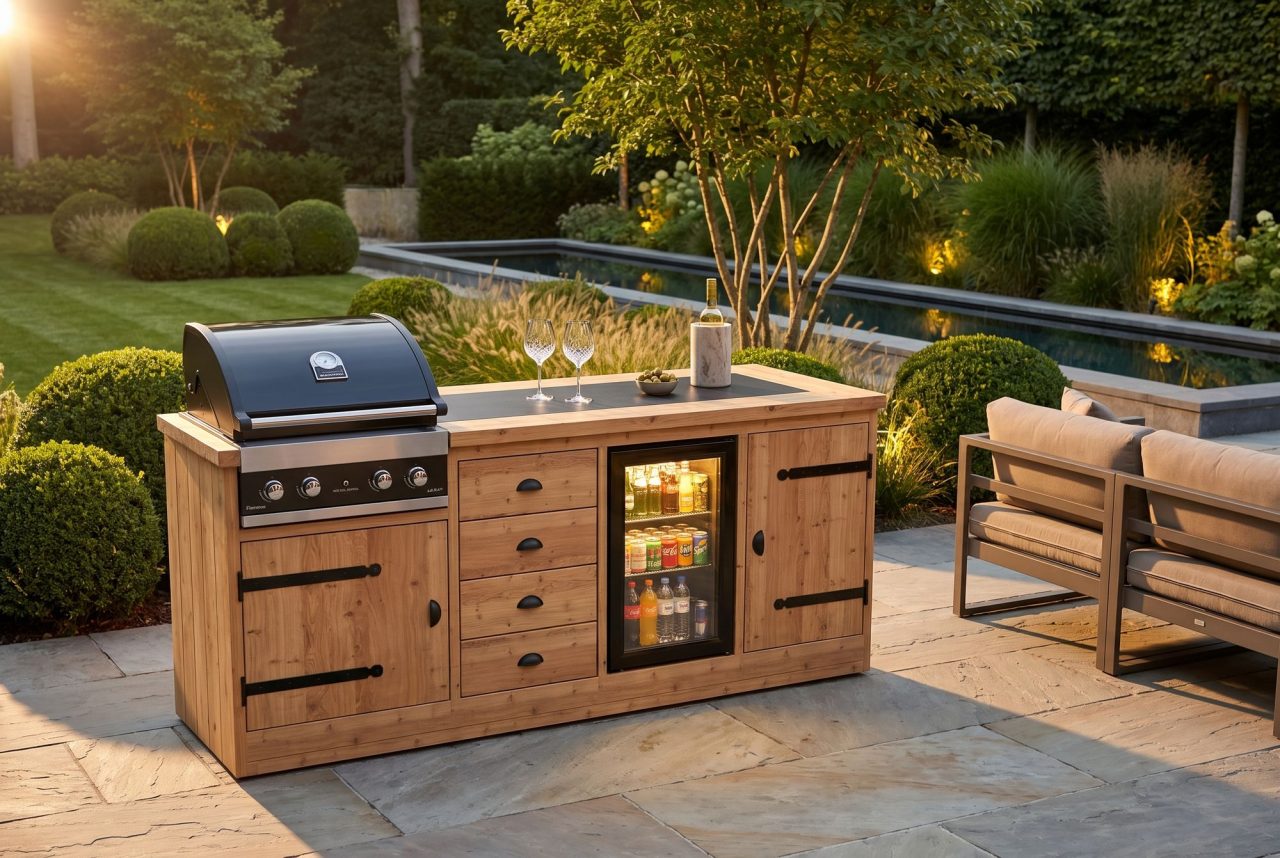
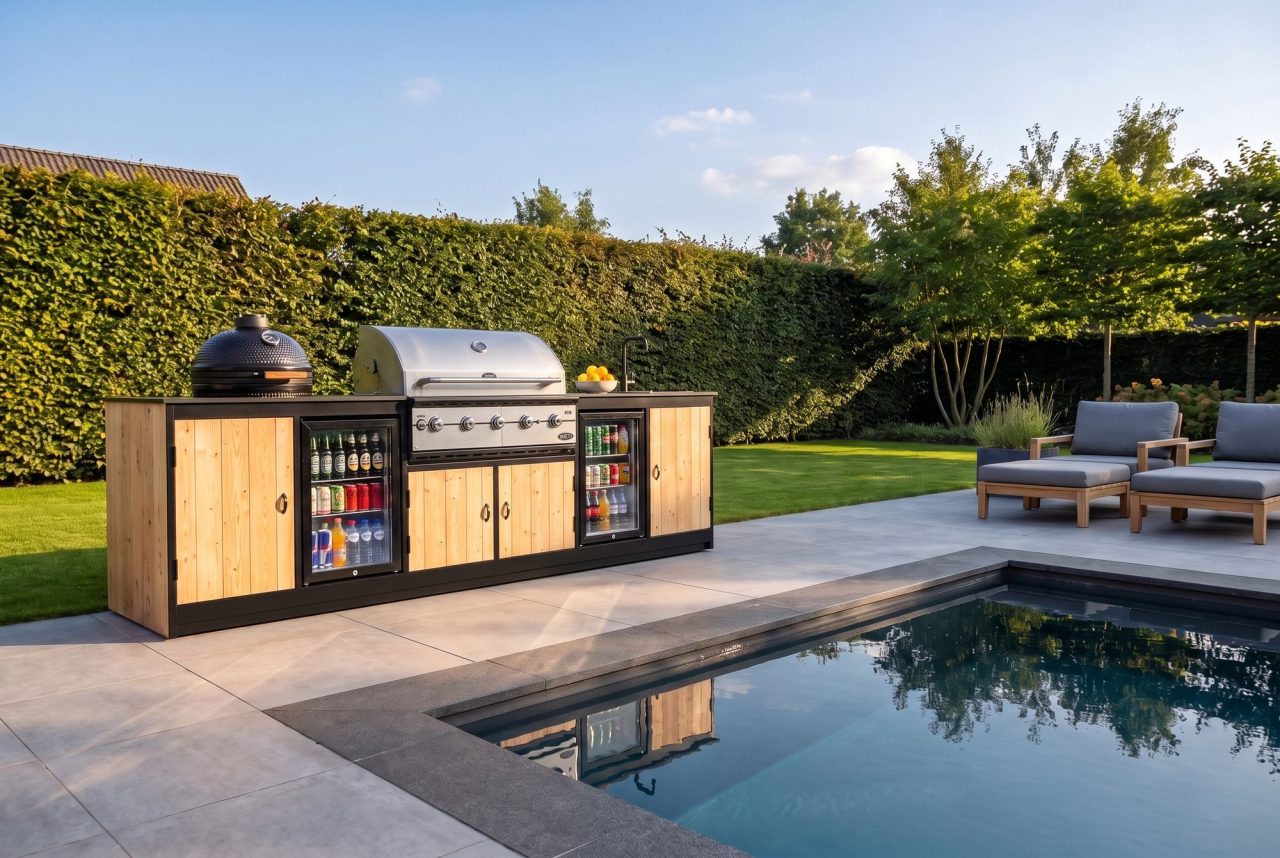
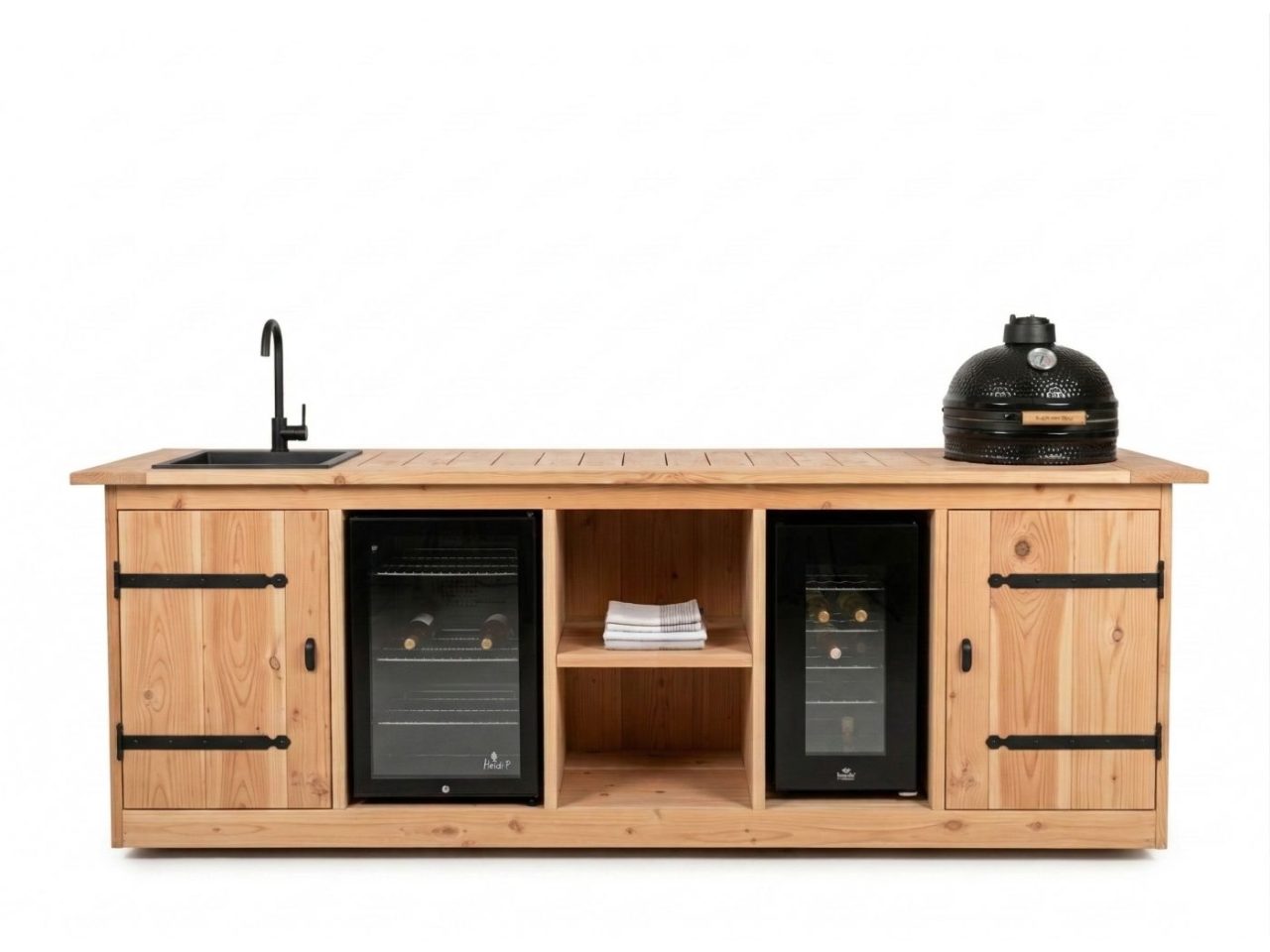
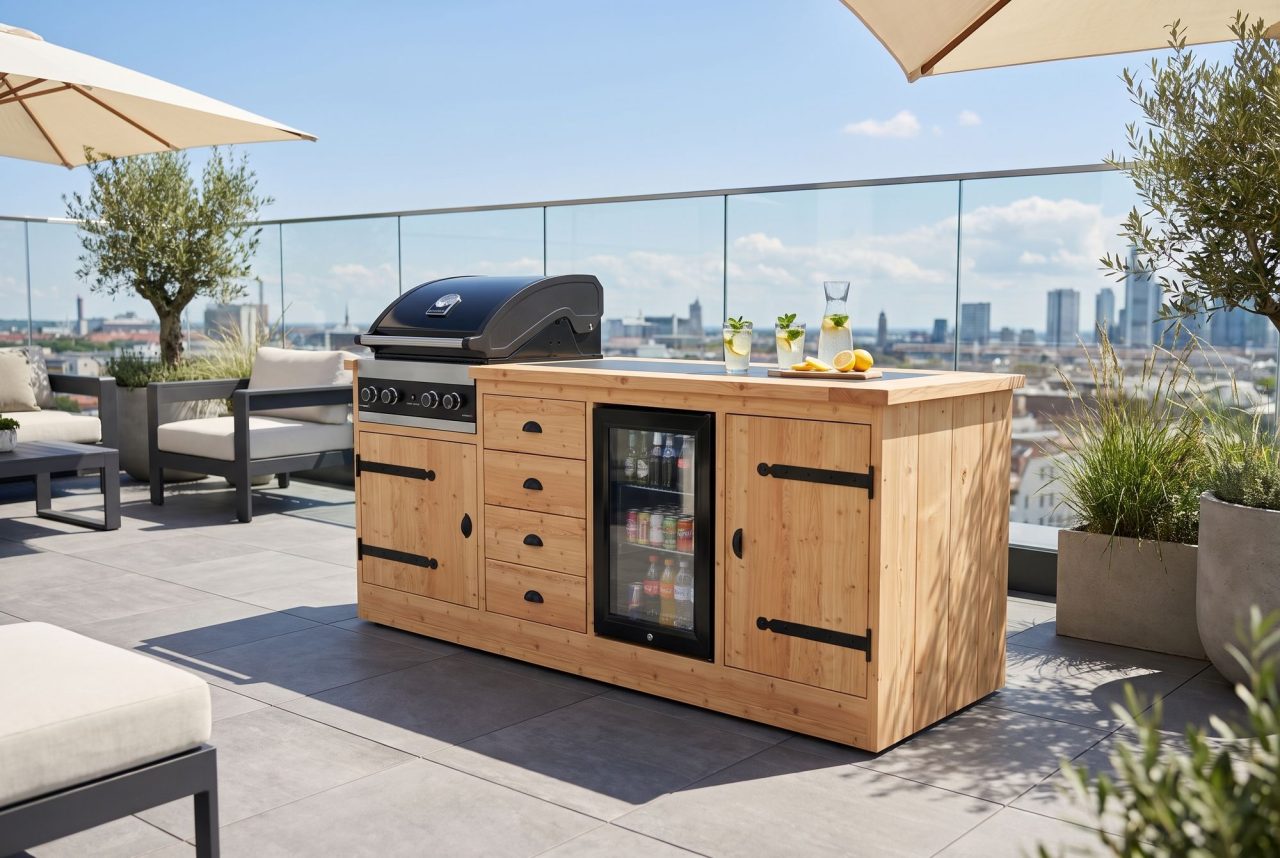
Building your own outdoor kitchen is perfectly doable if you can handle a circular saw and a cordless drill. You build a frame from Douglas fir or pressure-treated timber to a working height of 90 centimetres, with a worktop 60 to 65 centimetres deep and a cut-out for the grill. Allow two to four weekends of work. In this guide you'll find the dimensions, the choice of materials and the mistakes self-builders make most often. We build outdoor kitchens ourselves in our workshop in Almelo, so the pitfalls below come from practice. And to be honest: it rarely ends up cheaper than you thought beforehand.
The right dimensions for a self-built outdoor kitchen
The dimensions of an outdoor kitchen start with the working height. 90 centimetres is the standard that also applies to fitted kitchens indoors, and it suits most people. If you're well over 1.90 metres tall, make the worktop 95 centimetres high. For worktop depth, 60 to 65 centimetres is usual. Deep enough for a chopping board with spices and bowls behind it.
The cut-out for a kamado demands precision. A 16-inch kamado has a grate of about 40 centimetres, but the outside dimensions of the ceramic body are considerably larger. In our own worktops we keep to a cut-out with a maximum diameter of 60 centimetres, and a 16- or 18-inch kamado then fits with a little room to spare. Measure your own grill at its widest point, including the hinge, and add a few centimetres for heat expansion and cleaning. A Kamado Joe has different dimensions from a Monolith or a Big Green Egg, so only rely on a construction drawing from the internet once you've measured.
Think about the overall length too. Grilling and preparing side by side quickly calls for 2 metres, and then you still have no space for plating up. For comparison: our standard models run from 109 to 301 centimetres, and the most popular sizes are right in the middle.
Which wood should you use for an outdoor kitchen?
When it comes to which wood to choose for an outdoor kitchen, three types are the obvious candidates: Douglas fir, pressure-treated spruce and scaffold boards. Douglas fir offers the best combination of price and lifespan. Its heartwood is classed as moderately durable under DIN EN 350-2 (durability class 3, or 3 to 4 for European Douglas fir), because the resin in the heartwood hardens and protects the wood from within. The sapwood falls into class 5, so look for boards with as little pale sapwood as possible.
Pressure-treated spruce costs less, but the treatment mainly protects the outside: every saw cut you make leaves the wood vulnerable again and has to be treated afterwards. Scaffold boards are the cheapest and look rustic, but vary widely in quality, so pick them out board by board at a DIY store such as Hornbach, Obi or Bauhaus.
Whatever you choose, buy dried and planed timber. Fresh, wet wood moves: it shrinks and warps in the first dry summer, and then the cabinet doors stick or the joints in the worktop open up. As a guide: a square-edged Douglas fir board measuring 18 x 145 x 2500 mm, planed on all four sides and dried, costs 11.90 euros at Hornbach in Germany, or 4.76 euros per metre (as of September 2026). That is exactly why we only work with Douglas fir that has been planed on both sides and dried.
Stainless steel screws and hinges
Use stainless steel screws and hinges for an outdoor kitchen, because galvanised steel rusts as soon as the zinc layer is damaged. And that is guaranteed to happen when you drive the screws in. Choose A2 stainless steel for a normal inland garden and A4 if you live near the coast, because the salt in sea air does get to A2 over time. With Douglas fir, pre-drill along the edges. Otherwise the wood splits at the ends, and you only see it once the screw is already in.
Foundation and weight
An outdoor kitchen with a kamado is heavy, and that weight rests on a small area. So place the kitchen on paving, concrete slabs or patio slabs laid on a compacted sand bed. Lawn and garden soil give way under the weight. Once a kitchen has sunk unevenly, getting the whole frame level again is almost impossible. Any self-builder it has happened to will tell you so. If you place it on existing patio slabs, check that they are level. A centimetre's difference shows in every door gap.
Keep a distance from combustible materials around the grill. A kamado radiates less heat from its outer surface than an open grill, but the area around the cut-out still gets hot. Surround it with a heat shield or a stone border, and leave space between the kitchen and a wooden fence or low-hanging plants.
Do you need planning permission for an outdoor kitchen?
An open, free-standing outdoor kitchen in the garden generally doesn't need permission, but the rules depend on where you live. In Germany, for example, they differ from one federal state to the next: what counts is the state building code and the local development plan. Things get critical as soon as the kitchen gets a foundation, a fixed roof, enclosed walls or fixed connections for water, electricity and gas, or if it stands close to the property boundary, because minimum distances then apply.
An example for roofing: the building code of North Rhine-Westphalia lists certain patio roofs up to 30 square metres in area and 4.50 metres deep as exempt from permission, while other German states set different limits. If you're planning a roof or a masonry kitchen, give your local planning or building authority a quick call beforehand and describe the project in concrete terms. It takes a quarter of an hour and saves you a letter from the authorities afterwards.
Connecting water and electricity
Water and electricity are what really make an outdoor kitchen complete, and that is exactly where self-builders most often get stuck. If you want to install a water connection in your outdoor kitchen, you need a supply pipe that you can drain in winter, otherwise it will freeze.
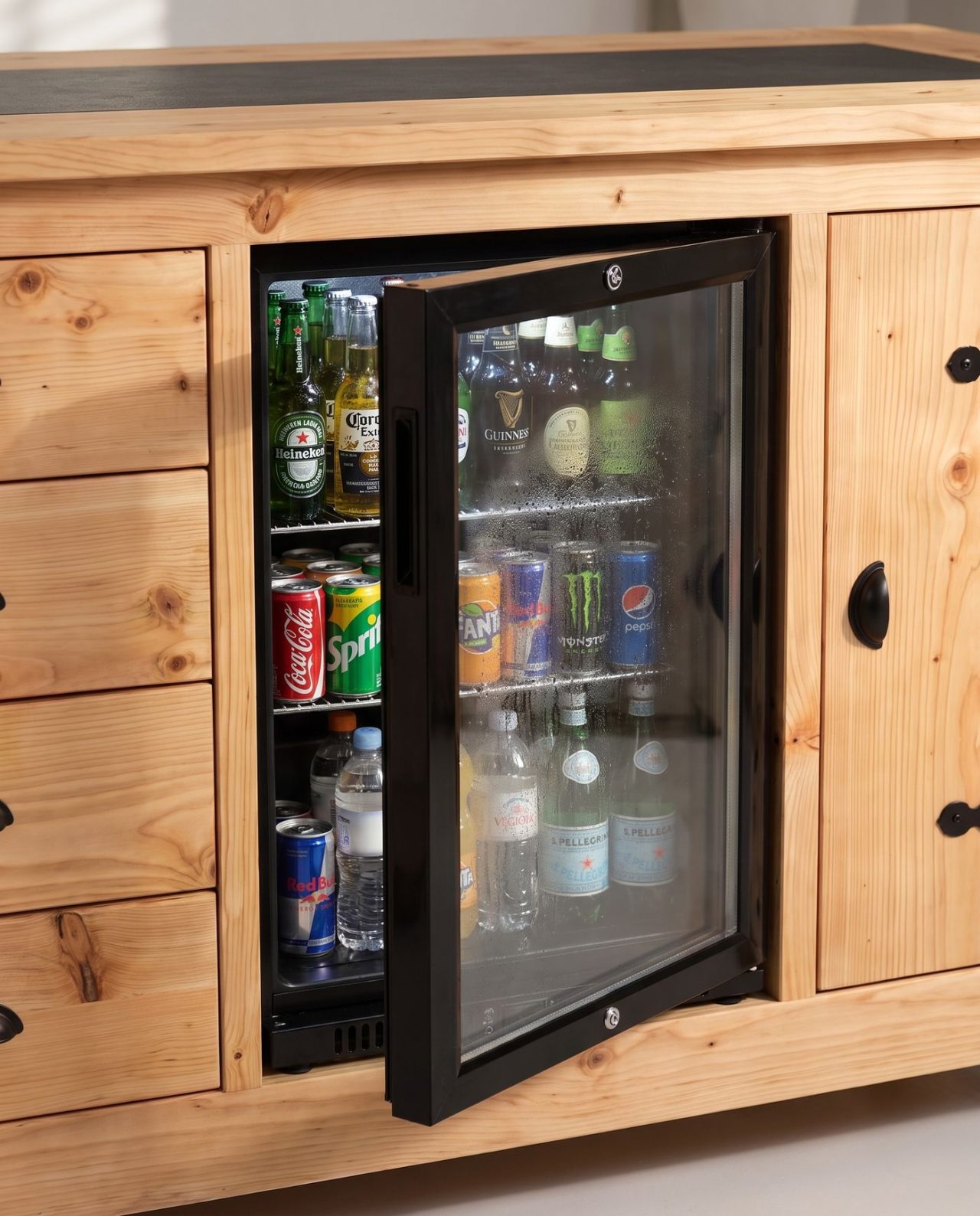
For electricity you need a splash-proof outdoor socket on its own circuit if a fridge is connected to it. That fridge runs day and night: our fridges use 321 to 445 kWh a year, which at the current German household electricity price of 37.0 cents per kWh (BDEW, as of August 2026) comes to 119 to 165 euros of electricity a year. Leave the installation of an outdoor circuit to an electrician. Outdoor electrics are the wrong place to save money with DIY.
How much does it cost to build your own outdoor kitchen?
The cost of a self-built outdoor kitchen comes down to four items: wood, worktop, fixings and appliances. Take your materials list round the DIY store or timber merchant and work everything out before you start, because the little things are easily forgotten. Stainless steel screws, hinges, oil or stain and a cover are missing from almost every budget we see from self-builders.
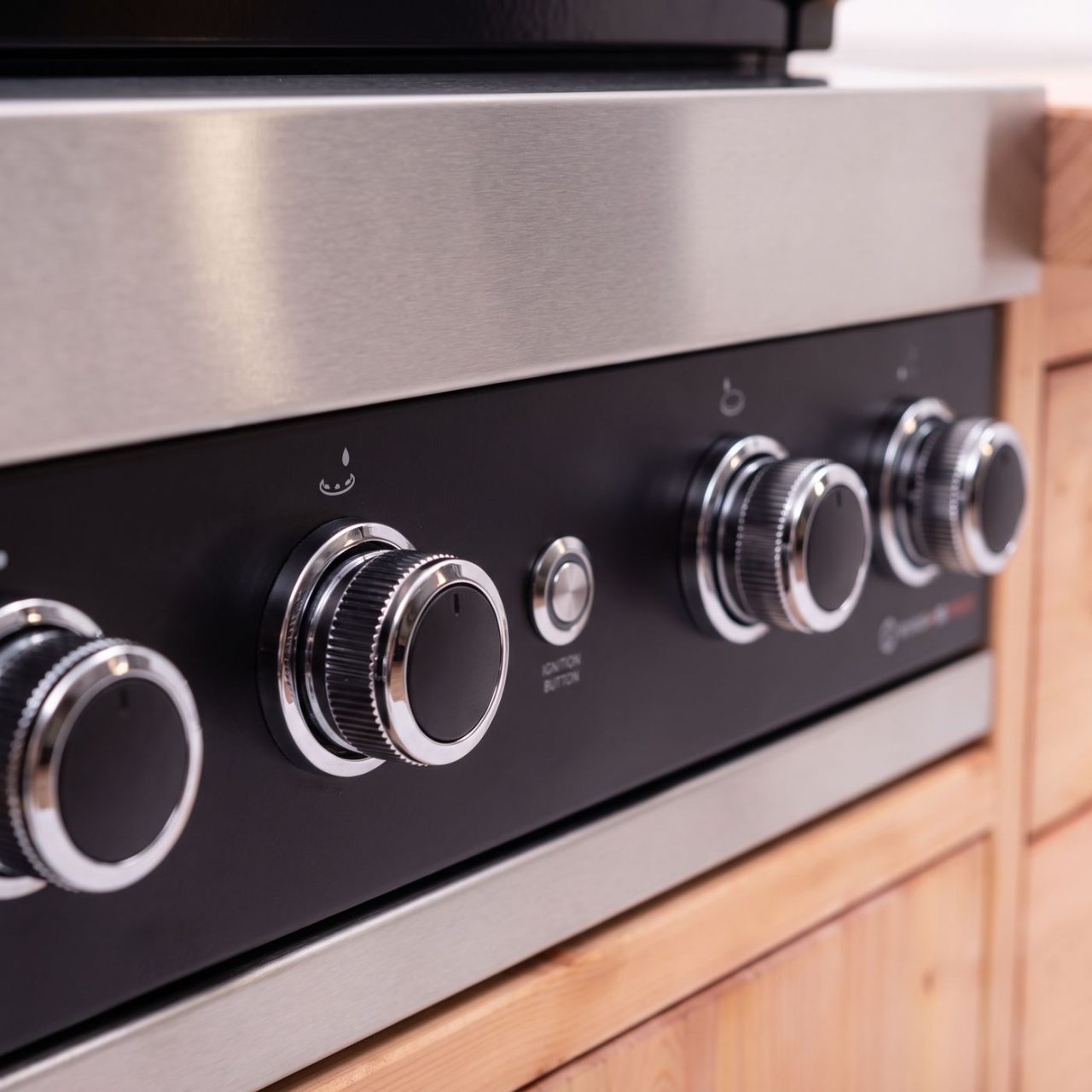
In the end, the appliances determine the budget: add up the kamado or built-in gas grill, fridge and tap, compare that with what an outdoor kitchen costs, and you'll know whether the project makes sense. Also factor in the annual electricity cost of a fridge, which quickly comes to 119 to 165 euros.
How to build the frame, step by step
The build takes five steps, and the order matters more than the speed:
-
Draw the design to scale, with all dimensions and the positions of the grill, sink and fridge. Mark holes for pipes and cables now, before you build.
-
Build the frame from square timbers, with a post at each corner and extra posts under where the kamado will sit. Check every joint with a try square.
-
Fit the worktop and saw the cut-out for the grill. Treat the cut edges straight away, including the underside.
-
Fill the kitchen with shelves, doors and appliances, and make the openings for gas, water and electricity.
-
Finish off: sand lightly, treat all the wood with exterior stain or natural wood oil for outdoor kitchens, and repeat this treatment every year.
Build it yourself or have it built?
Building it yourself costs the least money and brings the most satisfaction. That is the honest assessment. You only pay for materials and decide every centimetre yourself. On the other side are two to four weekends, plus tools you have to own or borrow, and mistakes in the worktop or foundation only show up after a season.
If you'd rather have the result than the project, that's where we come in. We build our outdoor kitchens in Almelo from the same Douglas fir, planed on both sides and dried, and deliver them fully assembled across Europe. In the configurator you can decide the layout of a made-to-measure outdoor kitchen yourself. Two routes to the same spot in your garden. Choose the one that suits your hands and your diary.
Frequently asked questions
Do you need permission for an outdoor kitchen?
An open, free-standing outdoor kitchen is generally exempt from planning permission. What counts are your local building regulations; in Germany, for example, the building code of your federal state and the municipality's development plan. As soon as a foundation, a fixed roof, enclosed walls or fixed water and gas connections are involved, or the kitchen stands close to the property boundary, check with your local building authority, ideally with a concrete project description.
Which wood is best for building your own outdoor kitchen?
The best wood for a self-built outdoor kitchen is Douglas fir: heartwood in durability class 3 under DIN EN 350-2 and considerably cheaper than hardwood. Pressure-treated spruce costs less but is vulnerable at saw cuts. Scaffold boards vary widely in quality. Always buy dried and planed timber, otherwise the frame will warp in the first summer.
How high should an outdoor kitchen be?
Build an outdoor kitchen 90 centimetres high, the same working height as a fitted kitchen indoors. If you're well over 1.90 metres tall, choose 95 centimetres. Keep the worktop 60 to 65 centimetres deep, enough for a chopping board with bowls and spices behind it. Always measure the cut-out for your kamado at its widest point, including the hinge.
How much does it cost to build your own outdoor kitchen?
The cost of a self-built outdoor kitchen is made up of wood, worktop, stainless steel fixings and appliances, and it is the last item in particular that determines the budget. Price up your materials list in advance at a DIY store such as Hornbach, Obi or Bauhaus, and include oil, hinges and a cover from the start. A fridge also costs 119 to 165 euros of electricity a year at the current German household price of 37.0 cents per kWh.
How long does it take to build your own outdoor kitchen?
Building your own outdoor kitchen takes two to four weekends, depending on your experience and the design. Drawing up plans and getting materials often takes another weekend. Mistakes in the foundation or worktop also only show up after a season. If you want to get there faster: Varetti builds outdoor kitchens from dried Douglas fir in Almelo and delivers them fully assembled across Europe.
Does Varetti build made-to-measure outdoor kitchens?
Varetti builds made-to-measure outdoor kitchens via the configurator, in addition to 22 standard models in widths from 109 to 301 centimetres. Everything is made in our workshop in Almelo, near Enschede close to the German border, from Douglas fir planed on both sides and dried, and delivered fully assembled. You choose the kamado, built-in gas grill, 70-litre fridge and sink yourself.