The short answer: use charcoal for short, hot grilling and briquettes for long, even cooking. Charcoal is ready in 10 to 25 minutes, reaches peaks of 600 to 800 degrees and has given off most of its heat after about an hour. Depending on the brand and how you light them, briquettes take 15 to 60 minutes, then settle at 500 to 600 degrees and glow for 3 to 5 hours.
For searing steaks, reach for charcoal; for spare ribs or pulled pork, briquettes. And for a long evening with a bit of everything, the two combine beautifully.
Charcoal and briquettes side by side
The standard values in the table come from the European standard EN 1860-2 (adopted in Germany as DIN EN 1860-2, the quality requirement for barbecue fuel); the practical values are based on figures from German manufacturers and barbecue guides.
| Feature | Charcoal | Briquettes |
|---|---|---|
| Lighting time | 10 to 25 minutes | 15 to 60 minutes |
| Maximum temperature | 600 to 800 degrees | 500 to 600 degrees |
| Burn time | about 1 hour, up to 2.5 hours in a closed grill | 3 to 5 hours |
| Fixed carbon (EN 1860-2) | at least 75 per cent | at least 60 per cent |
| Ash content (EN 1860-2) | no more than 8 per cent | no more than 18 per cent |
| Moisture (EN 1860-2) | no more than 8 per cent | no more than 8 per cent |
| Flavour | bold, smoky | more neutral |
The rows from the standard explain the difference in character. Charcoal is almost pure carbonised wood, so it burns hot and leaves next to no residue. Briquettes are made from compressed charcoal fines with a binder, which the standard requires to be food grade. They burn more slowly and steadily, and they are allowed to leave more than twice as much ash.
When should you choose charcoal?
Choose charcoal when you want to grill fast and hot: steaks, burgers, vegetables with a bit of bite, anything that is done in a few minutes. The high peak temperature of 600 to 800 degrees gives you a quick crust and that classic smoky aroma that is the reason many barbecue fans light up in the first place. The downside is the short burn time. After about an hour the heat drops off and you need to top up. For a beer after work and a few skewers that is perfectly fine; for a four-hour evening it becomes a chore.
When should you choose briquettes?
Choose briquettes as soon as the cook takes longer than an hour. Think spare ribs, pulled pork, a whole chicken or anything cooked indirectly with the lid closed. A layer of briquettes holds the temperature steady for 3 to 5 hours, and it is exactly this calm that makes low and slow possible while you sit back at the table. Allow for the slower start: depending on the type and your chimney starter, it takes 15 to 60 minutes before the briquettes are covered in a grey layer of ash and you can get going.
How much do you need for an evening?
A common rule of thumb in Germany is about 1 kilo of briquettes per hour of grilling. For a four-hour evening on briquettes you will therefore need around 4 kilos. For reference: one load for a kettle barbecue 57 cm in diameter is around 50 briquettes or about 2 kilos, so over four hours you top up once.
With charcoal you need more, because each load burns down faster: the German charcoal maker Holzkohlewerk Lüneburg reckons on 1 to 1.5 kilos of briquettes per person for a two- to three-hour barbecue, against 1.5 to 2 kilos of charcoal. A chimney starter shortens the start-up with either fuel and makes liquid firelighters unnecessary. Per evening, briquettes usually work out cheaper, although that depends on the brand.
Charcoal in a kamado
In a kamado (feel free to read up first on what exactly a kamado is), lump charcoal is the right choice, and it all comes down to ash. The EN 1860-2 standard allows briquettes an ash content of up to 18 per cent, charcoal no more than 8 per cent. A kamado draws its air through a small inlet at the bottom of the ceramic bowl, and that is precisely where twice the amount of ash collects. The result: the airflow stalls and the temperature drops in the middle of a long cook.
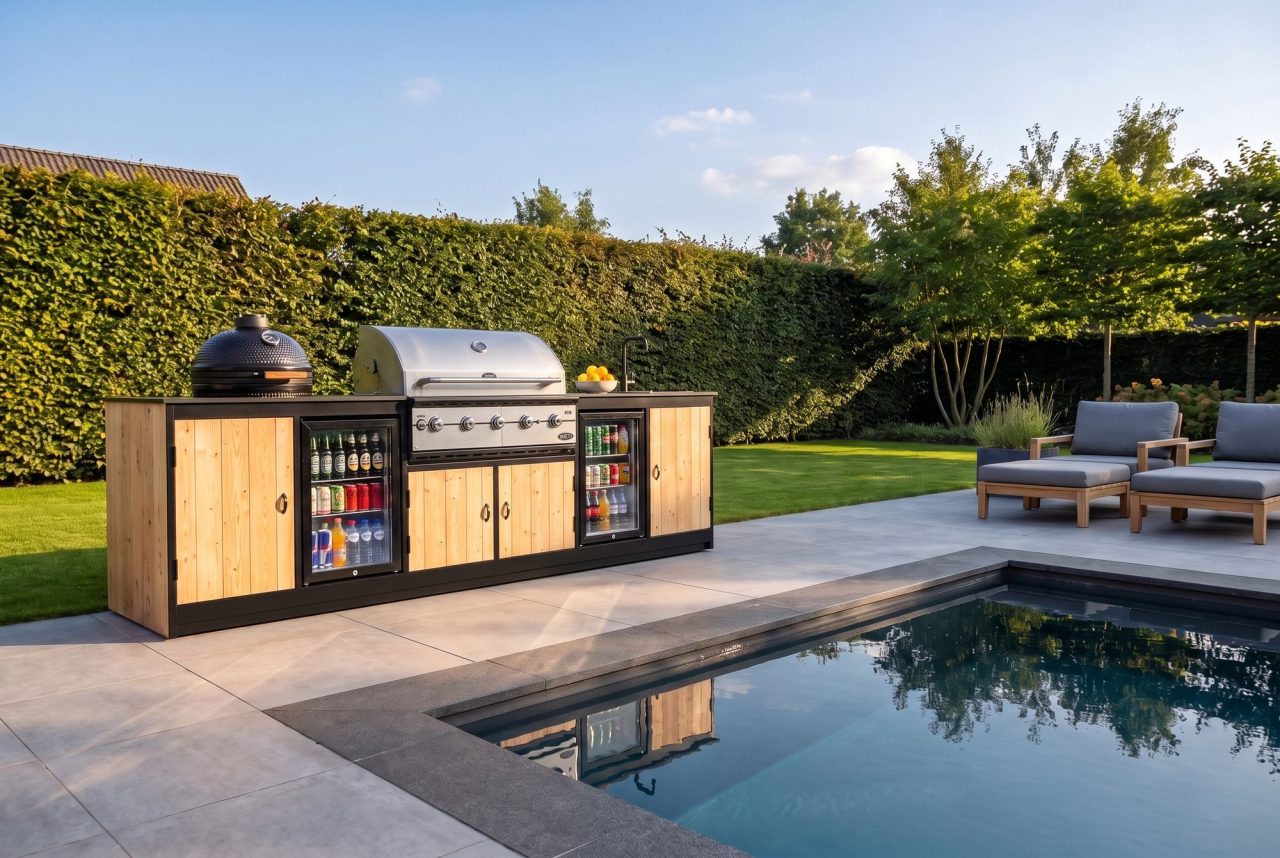
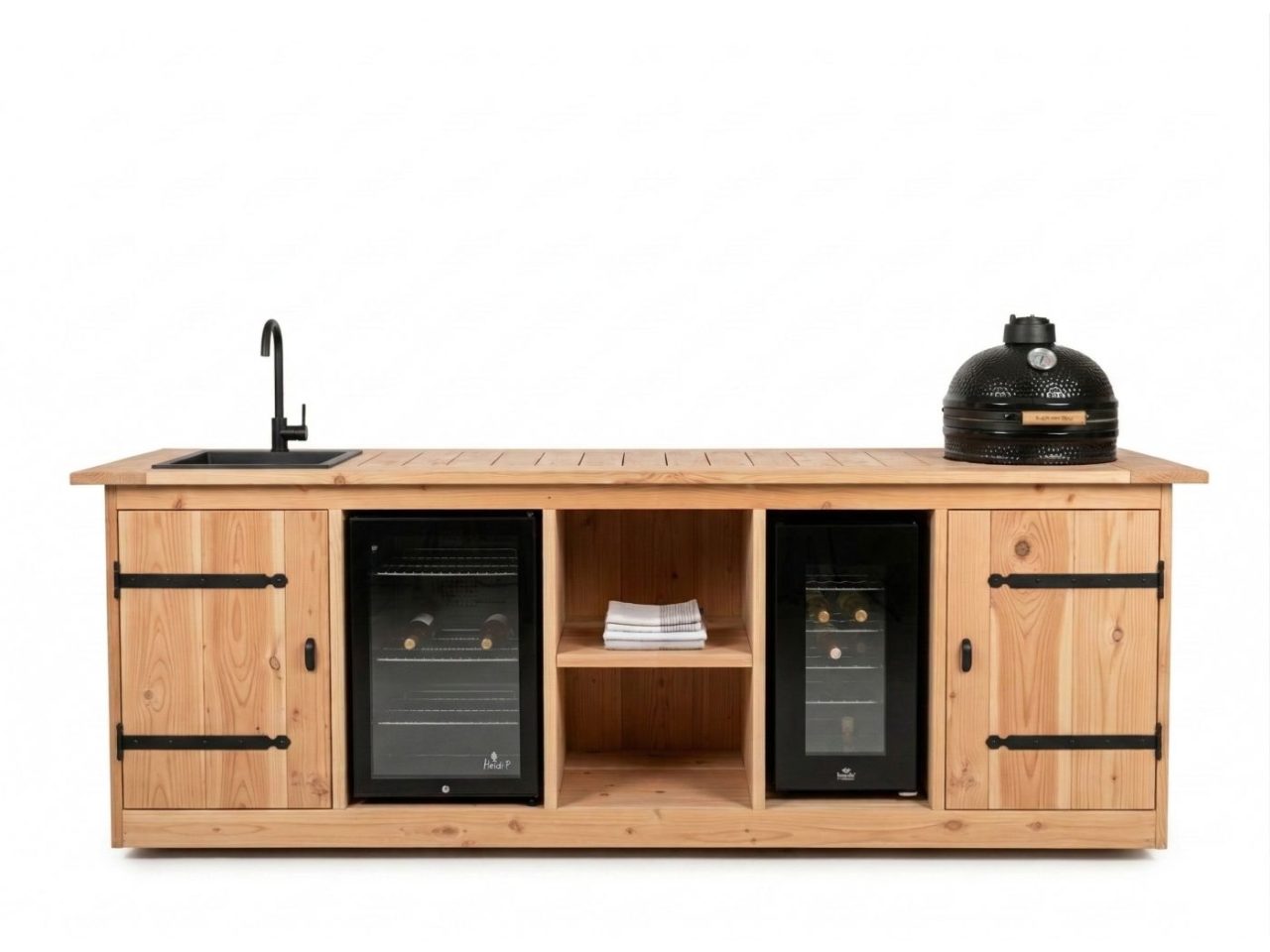
That is why the 16- and 18-inch kamados we build into an outdoor kitchen with a kamado always take lump charcoal. Incidentally, in a closed ceramic cooker like this it lasts far longer than the single hour in an open grill, because you throttle the oxygen supply. Ideal for long kamado recipes.
Mixing charcoal and briquettes
Mixing works brilliantly, and the order is crucial. Lay a base of briquettes for a steady, long-lasting bed of embers and light it. Then scatter a layer of charcoal on top for high heat and smoky aroma. If you do it the other way round, the charcoal is half burnt out before the briquettes are properly glowing. This way you get the best of both: the aroma and searing heat of charcoal on top of the staying power of briquettes. Honestly, for a long garden party evening in an outdoor kitchen with a grill, this is our favourite combination.
How to spot good quality on the bag
You can spot quality by the standard printed on the bag. Look for DIN EN 1860-2 or the DIN CERTCO test mark (TÜV Rheinland), which checks fixed carbon, ash content, total moisture and grain size. The standard requires charcoal to contain at least 75 per cent fixed carbon with no more than 8 per cent moisture, and briquettes at least 60 per cent fixed carbon, likewise with no more than 8 per cent moisture. For charcoal it also governs piece size: at least 80 per cent of the pieces must be larger than 20 mm, and no more than 7 per cent may be under 10 mm.
Additives such as coal, petroleum, coke, pitch, plastic, glass, slag, rust or metal fragments are prohibited, and chemical accelerants are not permitted either. A bag carrying the standard therefore tells you exactly what you are burning. Damp fuel that does not glow through properly costs you more in the end, because you need more of it to get up to temperature.
Frequently asked questions
Which burns better, charcoal or briquettes?
Charcoal burns hotter, briquettes burn longer. Charcoal reaches 600 to 800 degrees and has given off most of its heat after about an hour, while briquettes glow for 3 to 5 hours at 500 to 600 degrees. So which is better depends on what you are cooking: for short, hot grilling charcoal wins; for slow cooking with the lid closed briquettes win.
What is the difference between briquettes and charcoal?
Briquettes differ from charcoal in their slower start and larger amount of ash. Depending on the type they take 15 to 60 minutes to get going and, under DIN EN 1860-2, may leave up to 18 per cent ash, more than twice as much as charcoal. In return they last 3 to 5 hours, while charcoal delivers the searing heat for a steak.
Which fuel belongs in a kamado?
A kamado should be fuelled with lump charcoal. Under EN 1860-2 it leaves no more than 8 per cent ash, briquettes up to 18 per cent, and that ash collects at the small air inlet at the bottom of the ceramic bowl, where it restricts the airflow and with it the temperature. In a 16- or 18-inch kamado, lump charcoal glows for hours with the air supply throttled.
When mixing, what goes in first, briquettes or charcoal?
When mixing, the briquettes go in first. Light the layer of briquettes as a stable base and only scatter charcoal on top once they start to glow. Do it the other way round and the fast-burning charcoal is mostly gone before the sluggish briquettes are up to temperature, so you lose the searing heat just when you need it for steaks or burgers.
How many briquettes do you need for a barbecue evening?
For a barbecue evening, allow about 1 kilo of briquettes per hour, so around 4 kilos for four hours. One load in a kettle barbecue 57 cm in diameter is about 50 briquettes or 2 kilos. With charcoal you need more for the same evening: Holzkohlewerk Lüneburg reckons on 1.5 to 2 kilos of charcoal per person against 1 to 1.5 kilos of briquettes.