For a gas grill or outdoor kitchen, choose a propane bottle with a matching pressure regulator, which in Germany means 50 mbar. Propane vaporises down to about minus 42 degrees, while butane only vaporises reliably at temperatures above 0 degrees. The common sizes are 5 and 11 kg, as a red deposit bottle or a grey bottle you own. Here you can read which size suits how you grill, what a refill costs, how long a bottle lasts and how to house it safely in the kitchen's cupboard module.
Propane or butane? For outdoors the choice is simple
Propane is the logical choice for a grill and outdoor kitchen, because it keeps vaporising even in winter cold (if you grill with charcoal or briquettes, you can skip this paragraph). The gas supplier Tyczka gives an operating range down to minus 42 degrees Celsius. According to Tyczka, butane, which is mainly found in cartridges and small camping bottles, can barely be used at temperatures around freezing and is therefore mostly used in summer camping stoves.
You can tell the contents from the bottle straight away: in Germany, the red and grey steel bottles from DIY stores, petrol station forecourts and gas dealers contain propane. So if you grill in winter, go for propane, and it is widely available: the German DIY chains Bauhaus, Hornbach and Obi, petrol stations and gas suppliers such as Tyczka or Westfalen all exchange propane bottles.
Sizes and prices: 5 or 11 kg, red or grey
You choose a gas bottle for your grill by size and bottle type, and the price per kilo differs noticeably. The DIY store prices at Hornbach in Germany (as of 14 September 2026) give a good picture: a 5 kg propane refill costs 14.15 euros, so 2.83 euros per kilo. An 11 kg refill costs 28.20 euros, which is 2.56 euros per kilo. On your first purchase you also pay for the bottle itself. With the red deposit bottle you pay a one-off deposit, 30 euros for the 11 kg bottle at Hornbach, and get it back when you return the bottle.
The grey bottle is bought as an owned or user bottle. At Hornbach this involves a one-off usage fee of 38.20 euros (5 kg) or 55.25 euros (11 kg), which is kept even if you return the bottle later. After that, when you swap empty for full, you only pay for the refill in both cases. According to Tyczka, the red deposit bottles come in 5, 11 and 33 kg and the grey owned bottles in 5 and 11 kg.
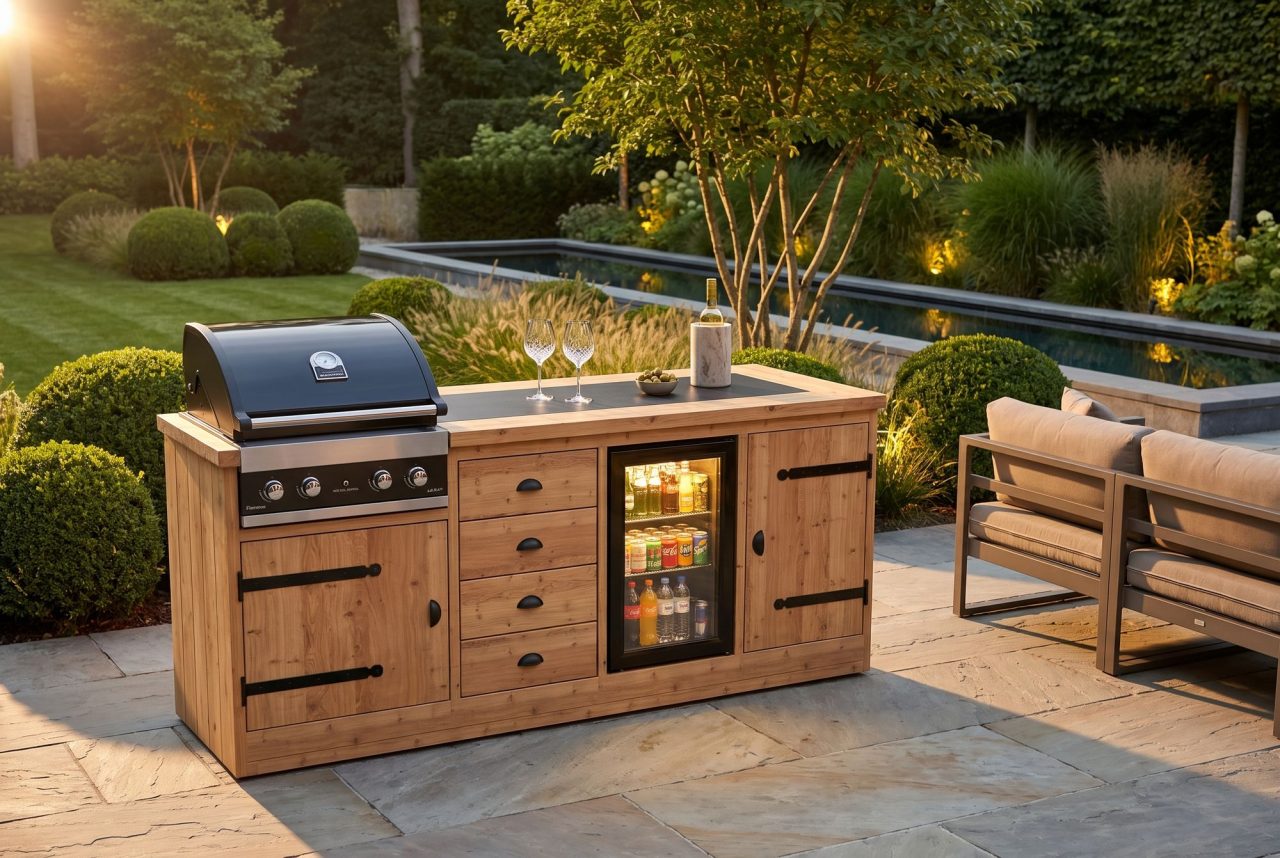
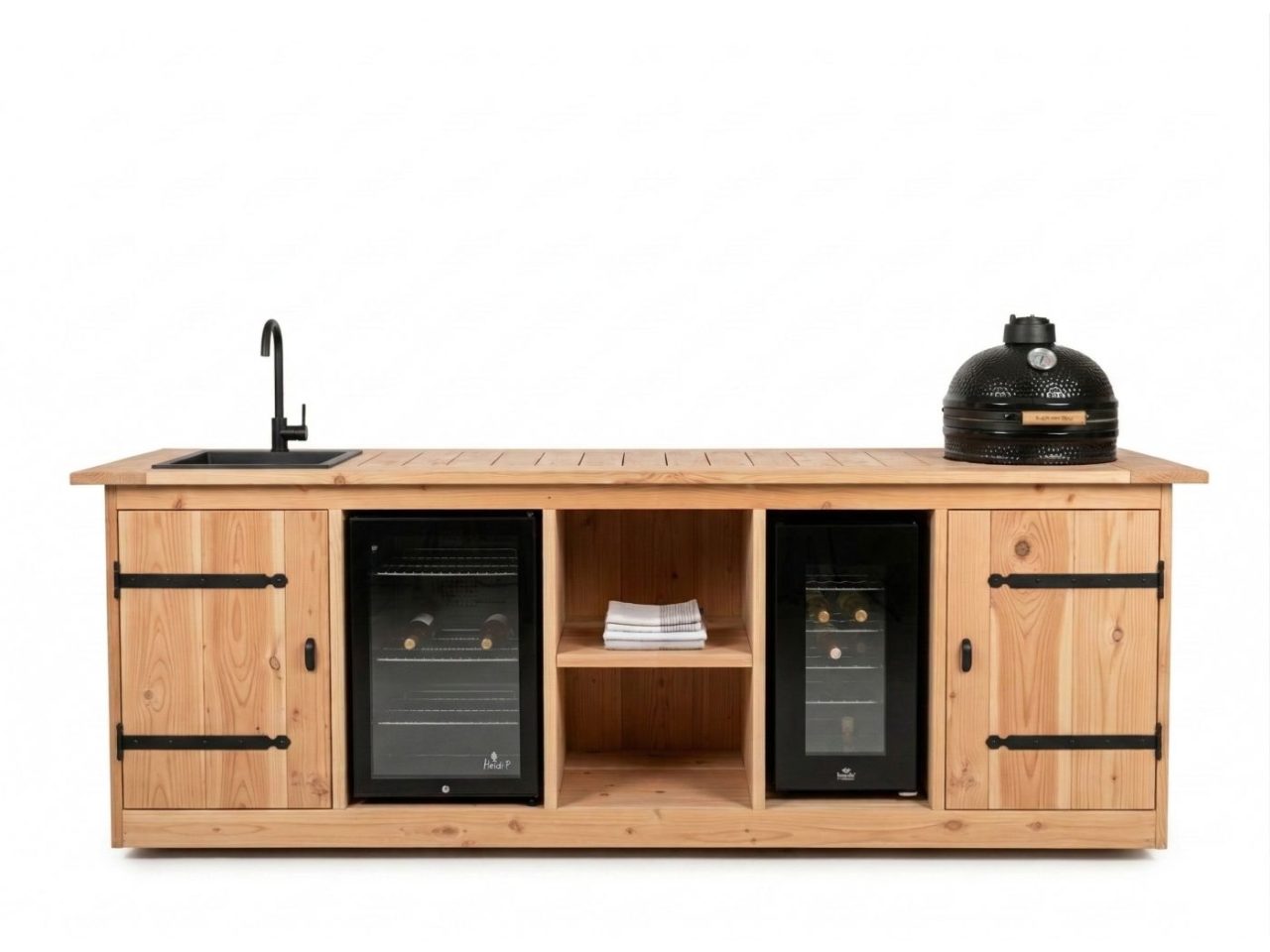
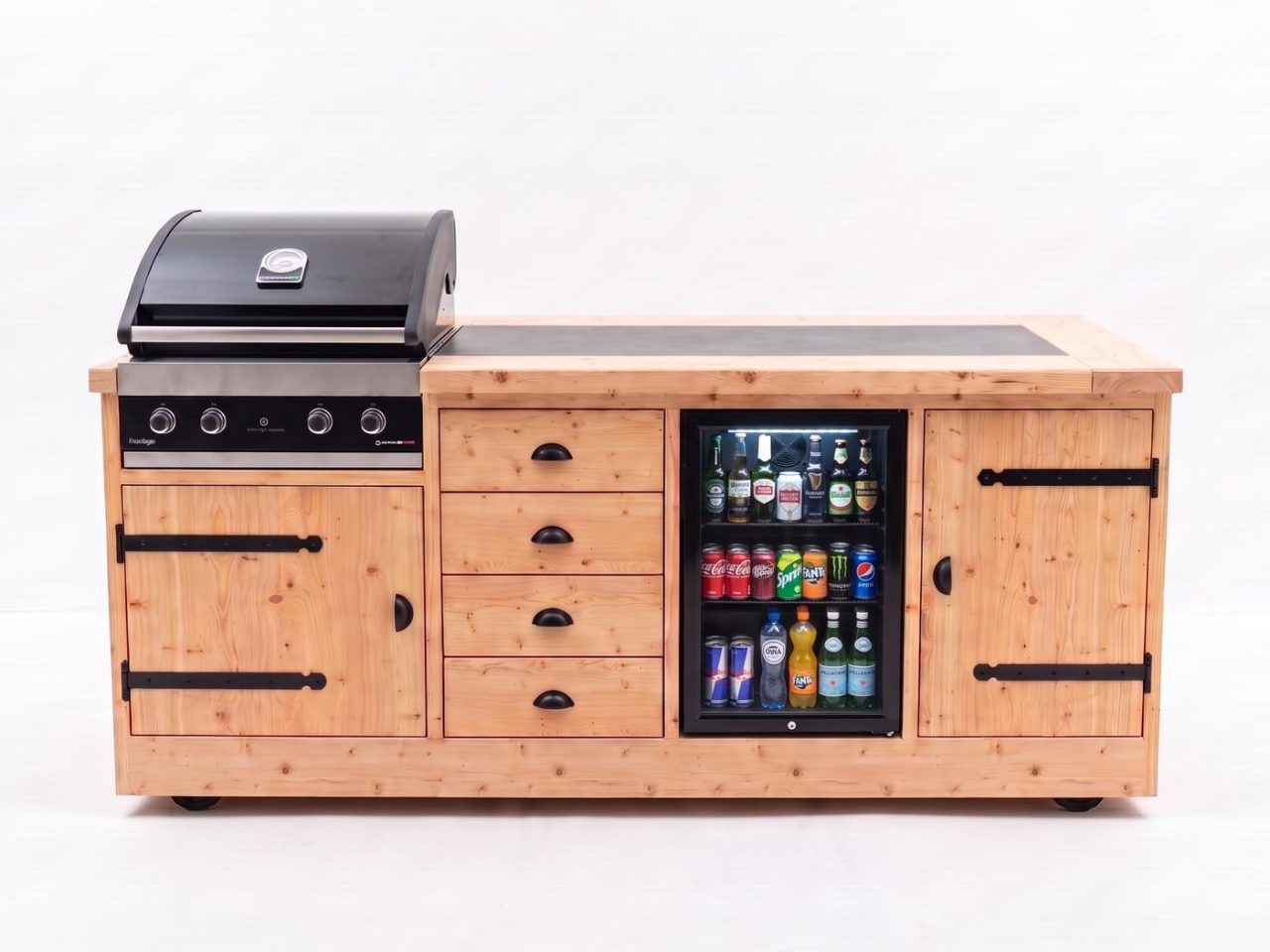
For an outdoor kitchen, size often matters more than price per kilo. According to Progas, the 5 kg bottle is 47.5 cm tall with its cap and 22.9 cm wide, so it fits in the cupboard module, connected directly to the built-in gas grill or gas hob of your outdoor kitchen with gas. If you grill every week, go for 11 kg and keep a spare bottle ready.
For most gardens, the 5 kg bottle is the most practical size.
How long does a gas bottle last?
Still unsure whether to go for an outdoor kitchen with gas or electric? You can work out how long a gas bottle lasts from the calorific value of propane. The gas supplier Progas gives 12.87 kWh per kilogram. A burner delivering 2 kW on a medium setting therefore uses around 155 grams of propane per hour (2 divided by 12.87).
With a 5 kg bottle you can grill on that one burner for a good 32 hours, with an 11 kg bottle for around 70 hours. If three burners run at full power at the same time, about 9 kW together, the same 11 kg is used up in just under 16 hours.
Want to know how much gas is left in the bottle? Weigh it. The empty weight (tare) is stamped on the collar; for a 5 kg steel bottle, according to Progas, it is about 5.8 kg. Everything above that is gas. That is more reliable than shaking or tapping.
Connection, pressure regulator and hose
A German propane bottle used for a gas grill needs a 50 mbar pressure regulator. According to Cadac, that is the operating pressure for gas appliances in Germany, Austria and Switzerland, while in the rest of Europe it is 30 mbar. Check your grill's manual quickly, especially for an appliance from another country or from the caravanning world, because 30 mbar applies there.
A 30 mbar appliance on a 50 mbar regulator gets too much gas: the regulator manufacturer GOK warns of oversized flames, incomplete combustion and overheating. Ideally, choose a regulator with a hose-break safety device that cuts the supply as soon as the hose slips off.
The gas hose has its date of manufacture printed on it. The German LPG association DVFG states that hose and regulator should be replaced no later than ten years after the date of manufacture. So parts from 2016 are due by the end of 2026. Porous patches or hairline cracks are a reason to replace them immediately. After fitting, check new connections with leak-detection spray or soapy water: bubbles mean a leak.
And one more winter tip from Tyczka: the standard hose can be used down to minus 30 degrees and goes stiff in the cold. Bring it somewhere warm for a while before connecting it.
Store the bottle safely and with ventilation
A gas bottle should stand upright in a well-ventilated spot above ground level, as required by the German Technical Rules for LPG (TRF), summarised by the DVFG. Propane is heavier than air and sinks to the ground if there is a leak. Cellars, bedrooms, hallways and stairwells are therefore ruled out as storage places, and a cupboard module with a gas bottle needs ventilation openings at the bottom so that any escaping gas can disperse.
According to the TRF, no more than one 5 or 11 kg bottle may be in use in living spaces, plus one more of the same size in reserve. Outdoors on private property you are free in terms of quantity; one spare bottle per appliance is plenty.
On top of that, three simple rules. Keep the bottle out of direct sun and at least one metre from sources of ignition, because heat raises the pressure in the bottle. For the same reason, the bottle stands to the side of the grill, away from the hot burners. Close the valve as soon as you have finished and put the protective cap on for storage. And transport the bottle upright, with the valve closed and secured, so that it stays in place in the boot.
Frequently asked questions
Which gas bottle is suitable for a grill?
A propane bottle with a 50 mbar pressure regulator (the standard in Germany) is suitable for a grill. According to Tyczka, propane vaporises down to about minus 42 degrees, so it works in winter too. The red deposit bottles and the grey owned bottles from DIY stores are both well suited. Choose 5 kg for the outdoor kitchen's cupboard module or 11 kg if you grill often.
How long does an 11 kg gas bottle last?
An 11 kg gas bottle lasts around 70 hours on a 2 kW burner at a medium setting. According to Progas, propane delivers 12.87 kWh of energy per kilogram. If three burners run at full power at the same time, the 11 kg bottle is empty in just under 16 hours. Weigh the bottle to find out what is left: the empty weight is stamped on the collar.
What is the difference between a red and a grey gas bottle?
The difference between a red and a grey gas bottle lies in ownership. The red deposit bottle (5, 11 or 33 kg) remains the property of the gas supplier; you pay a one-off deposit and get it back when you return it. The grey owned bottle (5 or 11 kg) belongs to you. Both contain propane and are swapped empty for full at the dealer.
Where is the best place for the gas bottle on a grill?
The best place for the gas bottle is to the side of the grill or in a cupboard module that is ventilated at the bottom and kept away from the hot burners. Heat raises the pressure in the bottle, so keep it out of the sun and at least one metre from sources of ignition. Keep the hose away from hot parts and check the connections with leak-detection spray.
How do you store a gas bottle in winter?
Store a gas bottle in winter outdoors or in a well-ventilated garden shed, always upright, with the valve closed and the protective cap on. Propane copes with frost without any problem and vaporises down to about minus 42 degrees. According to the TRF, the storage place should be above ground level, because propane is heavier than air and collects on the ground if there is a leak.