Douglas fir is the best choice for most outdoor kitchens. Its heartwood is in durability class 3 and lasts 10 to 15 years untreated. Spruce (class 4) manages 5 to 10 years outdoors untreated. Hardwoods such as oak or teak do even better, but cost considerably more and are hard to work. In this guide we set the common types of wood side by side, with durability class and maintenance effort, and name their weaknesses honestly too.
How to read durability classes
A wood's durability class tells you how well its heartwood resists wood-destroying fungi in contact with outdoor air and moisture, untreated. The classification comes from the European standard DIN EN 350 and runs from class 1 to 5:
| Class | Meaning | Lifespan untreated |
|---|---|---|
| 1 | Very durable | 25 years or more |
| 2 | Durable | 15 to 25 years |
| 3 | Moderately durable | 10 to 15 years |
| 4 | Slightly durable | 5 to 10 years |
| 5 | Not durable | Less than 5 years |
Important: the class only applies to the heartwood. Sapwood, the young wood on the outer edge of the trunk, falls into class 5 in every species. So a Douglas fir board with a lot of sapwood performs less well than its class suggests. Feel free to ask your timber merchant about it.
Types of wood for an outdoor kitchen compared
Six types of wood are the ones you will come across most often in outdoor kitchens. This is how they compare:
| Wood | Class | Untreated outdoors | Price level | Care |
|---|---|---|---|---|
| Pressure-treated spruce | 4 (impregnated) | 5 to 10 years | Lowest | Treat regularly |
| Scaffolding boards (spruce) | 4 | 5 to 10 years | Low | Treat regularly |
| Douglas fir | 3 | 10 to 15 years | Medium | Oil if you wish |
| Larch | 3 | 10 to 15 years | Medium | Oil if you wish |
| European oak | 2 | 15 to 25 years | High | Little |
| Teak | 1 | 25 years or more | Very high | Little |
The classes follow the DIN EN 350-2 classification as given by German timber websites. Some tables list Douglas fir and larch as 3 to 4, depending on the proportion of heartwood. Bangkirai (class 1) and western red cedar (class 2) also last a long time, but you will come across them less often in outdoor kitchens.
Pressure-treated spruce is cheap, with a catch
Pressure-treated spruce is the cheapest option for a wooden outdoor kitchen. The spruce is treated with wood preservatives under pressure, which makes it more resistant to rot and insects than raw spruce. Great for a garden fence, where you hardly notice any of this.
For an outdoor kitchen we see it differently. Spruce remains a soft wood that moves quite a lot: the boards are more likely to warp in changing weather than Douglas fir. And you prepare food on it. Next to our chopping board we would rather have wood that lasts naturally, so you are better off choosing a species that reaches a better class on its own merits.
Why we chose Douglas fir ourselves
Douglas fir combines a fair price with durability class 3, entirely on its own merits. That is exactly what the article on why an outdoor kitchen made of Douglas fir works so well is about. The wood naturally contains resin that keeps moisture out, and it is considerably stiffer and harder than spruce.
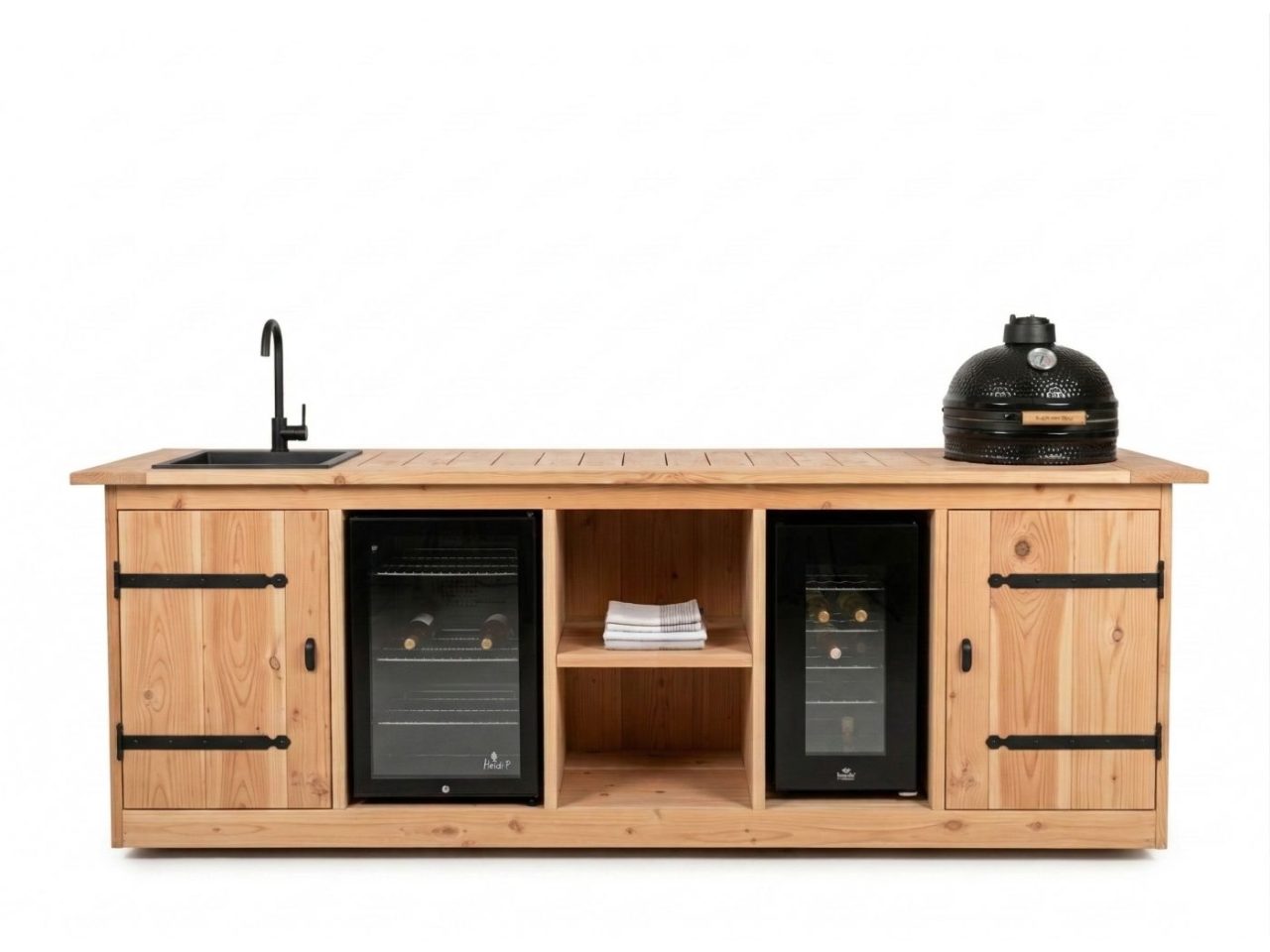
That is why we build all 22 standard models in our workshop in Almelo from Douglas fir, planed on both sides and dried. The drying is more than a detail: dried Douglas fir moves less, so doors and drawers still fit neatly after a few seasons.
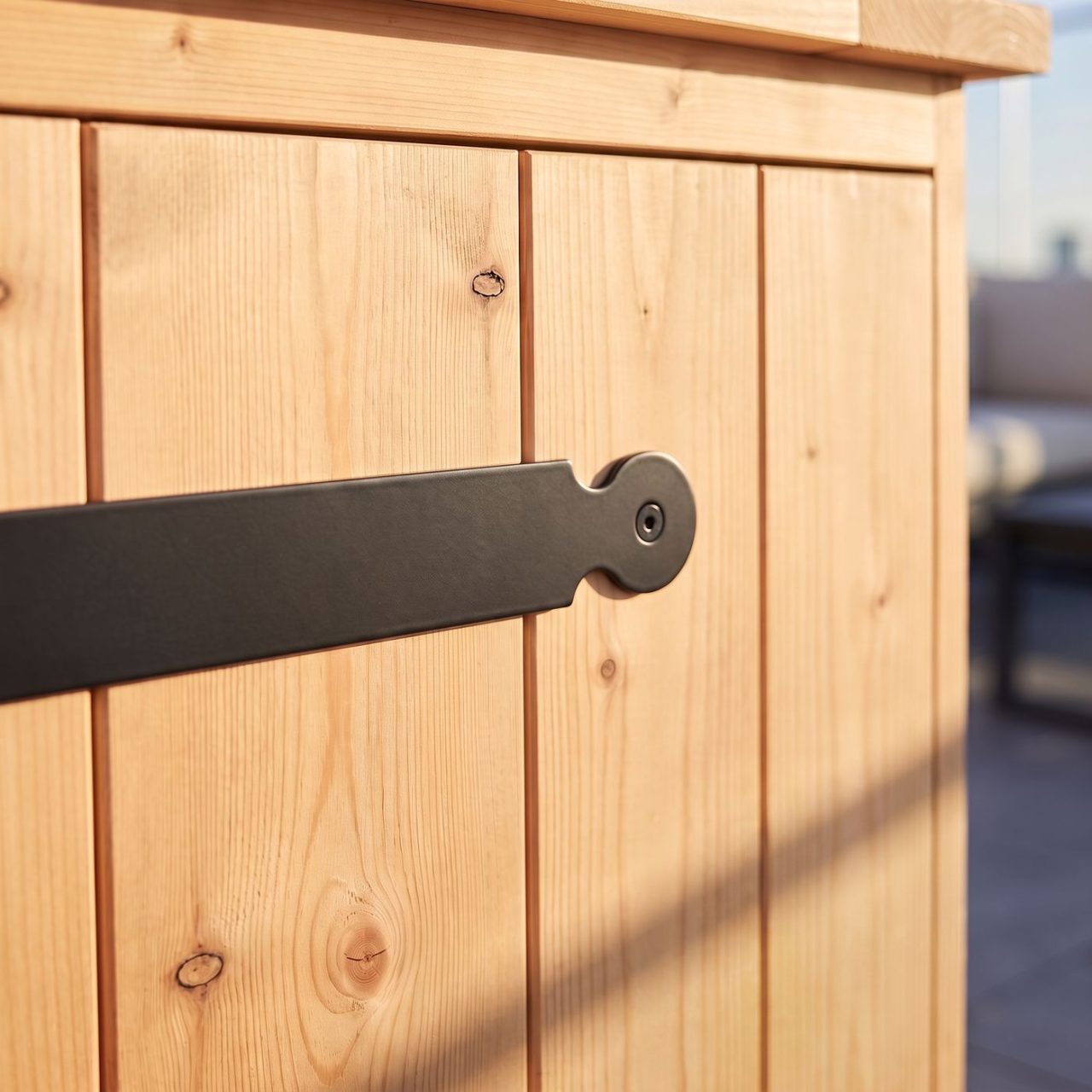
Good to know: Douglas fir turns grey. Untreated, its warm reddish-blond colour becomes silver grey within one to two years. That is purely cosmetic and says little about the quality.
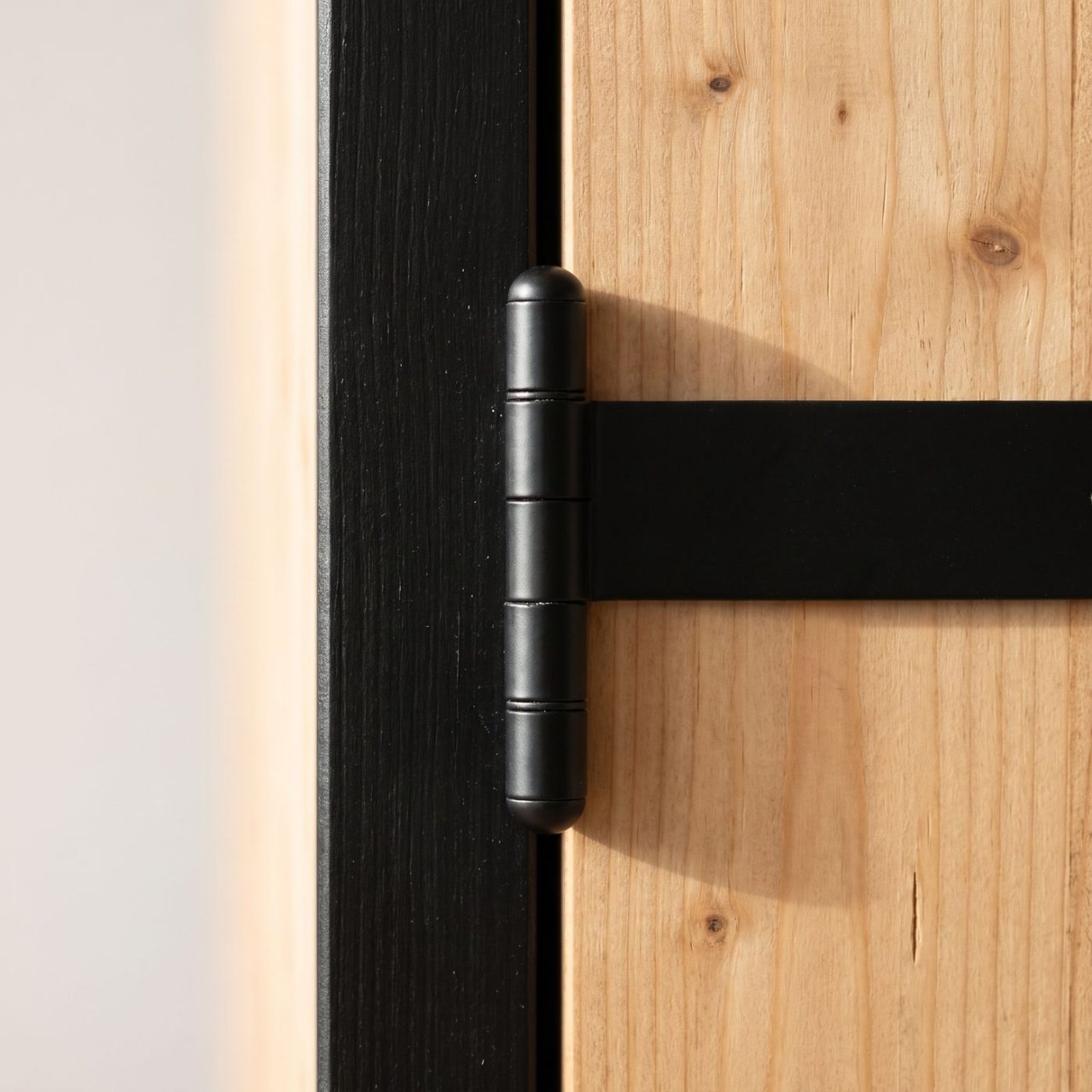
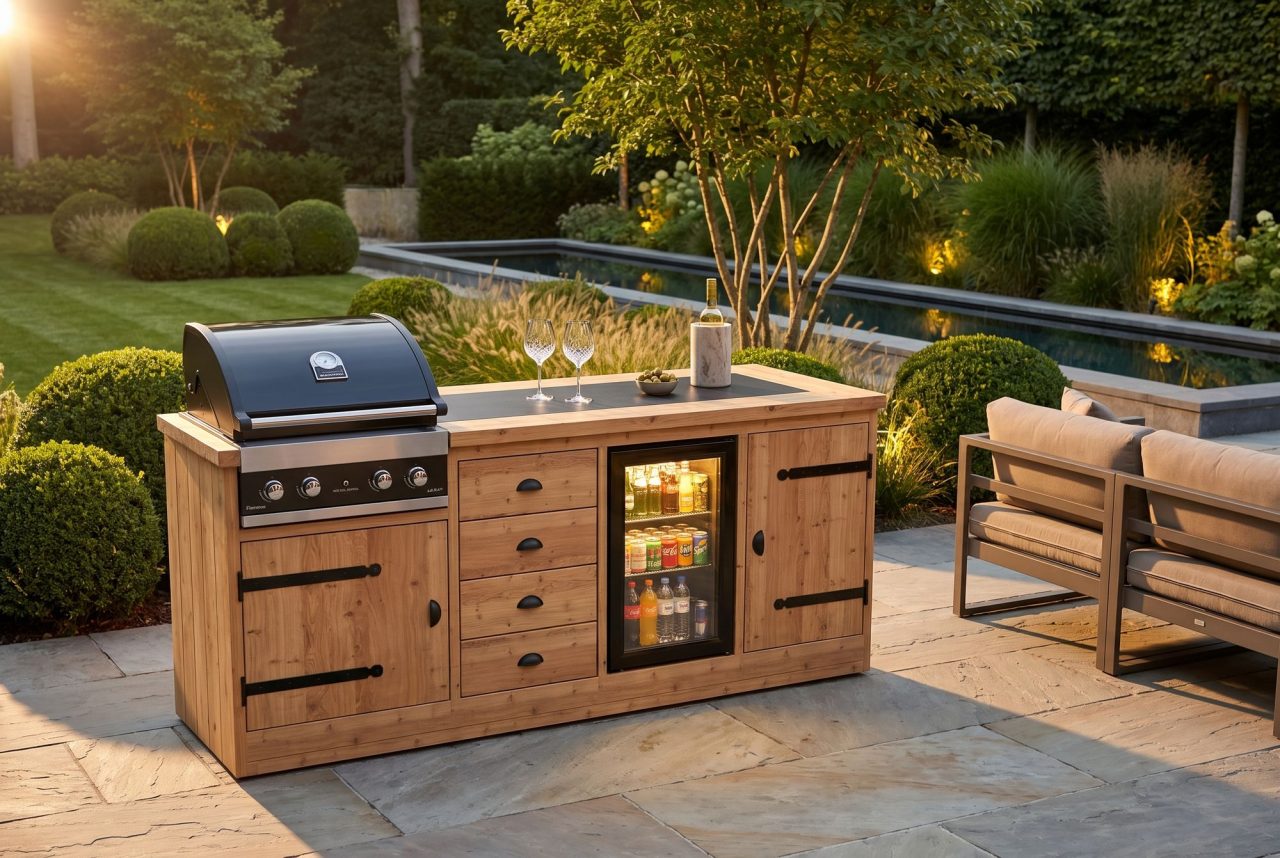
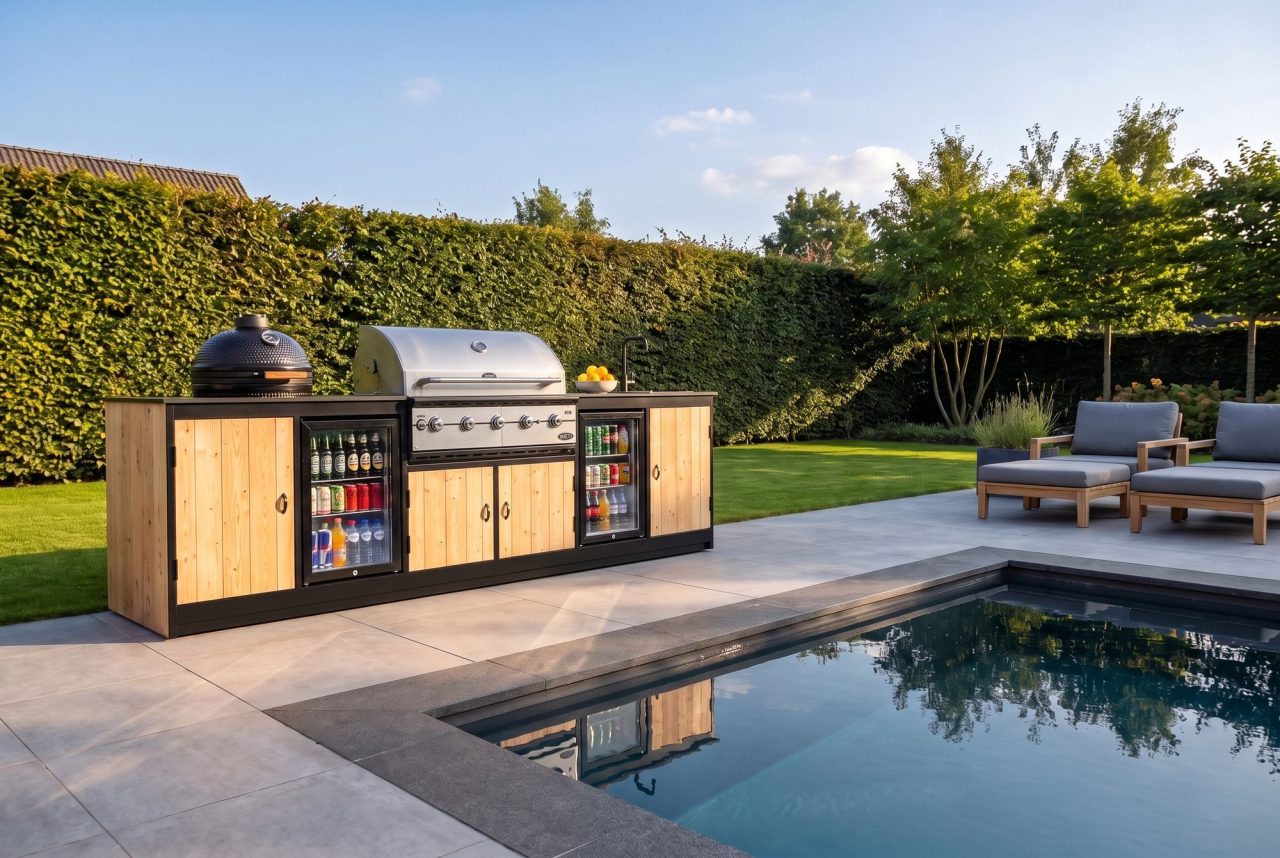
If you want to keep the warm tone, you can lock in the colour with oil. Douglas fir stained black works too, although the stain slowly fades in full sun. Take a look at the models made of Douglas fir and you will see the difference between a natural and a black frame straight away.
Scaffolding boards have charm, but they are still spruce
Scaffolding boards are simply spruce, so class 4. The worn look comes from the fact that the boards have often already had a life on a building site. If that lived-in look is exactly what you want, it is a logical choice. It is light, too.
Expect scaffolding boards to need more attention than Douglas fir. Treat them with oil or stain against moisture, and accept that they have more cracks and splinters. An outdoor kitchen made of scaffolding boards works well, as long as you know its untreated lifespan is shorter than that of Douglas fir.
Hardwood lasts longest and costs the most
If you want maximum lifespan, you end up with hardwood. European oak reaches class 2 and lasts 15 to 25 years untreated, while teak is in class 1 and survives more than 25 years outdoors. There is a flip side. Hardwood costs considerably more than Douglas fir, and anyone building with it themselves soon notices how quickly saw blades go blunt. Frankly, the weight is the biggest practical drawback: just try moving a kitchen like that.
So for the frame of an outdoor kitchen, hardwood is rarely the logical choice. The smarter option is the combination we often build: a Douglas fir frame with a 12 mm sintered stone worktop. That puts the abrasion resistance exactly where you cut and spill, and the frame stays affordable. You can read more about this in the worktop options.
How much care each type of wood needs
Looking after a wooden outdoor kitchen varies considerably depending on the wood. Pressure-treated spruce and scaffolding boards need the most attention: oil or stain keeps the moisture out, and only then does the lifespan stay at the upper end of the 5 to 10 years that class 4 promises. You can let Douglas fir go grey untreated, and the structure remains just as sound. Oiling is only necessary if you want to keep the colour. Hardwood needs almost no maintenance.
Whatever the wood, pay attention to this: put the kitchen on a level, dry base, make sure air can circulate under and behind the kitchen, and give the wood time to dry after a shower of rain. With natural oils you extend the life of wood outdoors.
Frequently asked questions
Which type of wood is best for an outdoor kitchen?
The best type of wood for an outdoor kitchen is Douglas fir. Its heartwood falls into durability class 3 under DIN EN 350, lasts 10 to 15 years untreated and reaches that on its own merits. Pressure-treated spruce is cheaper but moves more. Hardwoods such as oak or teak last longer and cost considerably more.
Which wood lasts longest outdoors?
Teak lasts longest outdoors: durability class 1 means more than 25 years untreated. Bangkirai is also in class 1, followed by European oak and western red cedar in class 2 with 15 to 25 years. Douglas fir and larch are in class 3 and last 10 to 15 years, spruce in class 4 no more than 10 years.
Are scaffolding boards suitable for an outdoor kitchen?
Scaffolding boards are suitable for an outdoor kitchen if you treat them. They are spruce in durability class 4, so untreated they last 5 to 10 years outdoors. Their lived-in look is their great strength. But expect more cracks, splinters and maintenance than with a Douglas fir outdoor kitchen.
How do you look after a Varetti outdoor kitchen?
You can look after a Varetti outdoor kitchen as much or as little as you like. The Douglas fir stays intact even untreated. It simply weathers from reddish blond to silver grey. If you want to keep the warm colour, oil the wood regularly. We supply Douglas fir planed on both sides and dried, so it moves less and stays straight.
Why does Varetti build with Douglas fir?
Varetti builds with Douglas fir because it offers the best balance of lifespan, price and workability. In our workshop in Almelo, in the east of the Netherlands near Enschede, we use it to make all 22 standard models in five widths from 109 to 301 cm. Douglas fir is stiff, naturally contains resin and reaches class 3 on its own merits, which is reassuring in a place where you prepare food.
What is the difference between Douglas fir and pressure-treated spruce?
The difference between Douglas fir and pressure-treated spruce lies in durability and treatment. Douglas fir reaches class 3 on its own merits, while spruce needs wood preservatives to remain usable starting from class 4. Douglas fir is also harder and stiffer, so a kitchen frame warps less. Spruce is cheaper, that much is true.